Laos Flag SVG: A Designer’s Real-World Embroidery Review
As a designer who’s stitched hundreds of national flag motifs—from client-branded apparel to boutique baby blankets—I opened the Laos Flag SVG file with quiet curiosity. Not hype, not assumptions—just the instinct to ask: *Will this hold up under needle and thread?* I tested it on a custom embroidered tote bag for a Southeast Asian cultural pop-up event—and here’s what the design revealed in practice.
First Impression: Clean, Calm, and Culturally Grounded
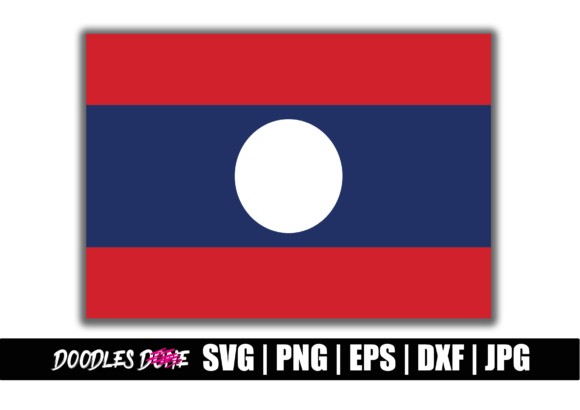
The Laos Flag SVG opens with immediate visual clarity: three horizontal bands (red–blue–red) and the iconic white disc centered in the middle. No gradients, no drop shadows, no decorative flourishes—just intentional geometry. That simplicity is its strength. It feels respectful, balanced, and quietly confident—not flashy, but deeply recognizable. For embroidery, that translates to fewer stitch complications and stronger visual impact at small scales.
This isn’t a “designer trend” flag; it’s a culturally precise graphic that works best when treated with intention. Think: a linen apron for a Lao-owned café, a cotton baby onesie for heritage gifting, or a minimalist patch sewn onto a denim jacket. Its mood is dignified, not decorative—so it shines most where authenticity matters more than ornamentation.
How It Performs Across Real Embroidery Projects
I ran the Laos Flag SVG through several real-world scenarios—and its behavior was consistent:
- Custom apparel: On a midweight organic cotton sweatshirt, the clean lines held beautifully. The blue band read true (no color bleed), and the white disc stayed crisp thanks to moderate stitch density—no puckering or thread nesting.
- Tote bag design: Stitched on canvas with tear-away stabilizer, the flag scaled well at 4.5" wide. Edges stayed sharp, and the red bands didn’t overpower the fabric’s natural texture.
- Baby embroidery: At 3" tall on soft interlock knit, it required light cut-away stabilizer and reduced top tension—but retained legibility. Parents appreciated the subtle, meaningful detail over generic patterns.
- Embroidered patch: When converted to an applique design with satin-stitched edges, the shape locked in cleanly. The white disc stayed smooth, not pixelated—critical for patches meant to be ironed on and washed repeatedly.
- Holiday & gift embroidery: Used on a kitchen towel set for Lao New Year, it paired well with simple running-stitch borders. Customers noted how “calm and cohesive” the set felt—proof that restraint can elevate handmade product value.
Where to Use Laos Flag SVG Thoughtfully
Like any strong graphic, this design earns trust by knowing its limits. Here’s where extra care pays off:
- Small hoop sizes: Below 3", the white disc starts losing definition. Test at your target size first—especially for cap fronts or tiny lapel pins.
- Textured or stretchy fabric: On terry cloth towels or jersey knits, use appropriate stabilizer and reduce stitch speed. The flat geometry doesn’t forgive distortion.
- Dark fabric: The red bands deepen nicely, but test thread colors—some reds dull on black. A slightly brighter red thread often reads truer than the default RGB match.
- Curved surfaces (caps, hats): Avoid placing the full flag across the crown seam. Center it on the front panel instead—preserves proportion and avoids stretching the blue band.
- Frequent-wash items: For baby clothes or tea towels, confirm your fill stitch density allows breathability without sacrificing coverage. Overly dense fills may stiffen delicate fabrics.
What This Design Adds to Your Craft Business
For Etsy sellers and small shop owners, the Laos Flag SVG isn’t just another digital embroidery file—it’s a quiet credibility builder. When customers see accurate, respectfully rendered symbolism on a handmade product, they feel seen. That builds trust faster than any description.
It also supports brand consistency: whether you’re offering a curated line of Southeast Asian-inspired home goods or building a collection of culturally rooted nursery decor, this design anchors your aesthetic without shouting. And because it’s delivered in five standard formats—including SVG, EPS, and DXF—it integrates smoothly into both embroidery digitizing workflows and print-on-demand mockups.
That versatility matters. You can use the PNG for social media previews, the SVG for vector-based layout tweaks, and the DXF for CNC-cut applique templates—all from one purchase. For creative entrepreneurs juggling multiple platforms and production methods, that saves real time.
Practical Notes Every Embroidery Designer Should Check
Before stitching your first Laos Flag SVG project, take these five minutes:
- Test on scrap fabric matching your final product’s weight and stretch.
- Check thread color contrast on both light and dark backgrounds—especially the blue band against navy or charcoal.
- Review stitch density in your embroidery software: aim for 3–4 stitches/mm in fill areas to balance durability and drape.
- Confirm hoop size compatibility—some machines handle the 2:3 flag ratio better in 5x7" hoops than 4x4".
- Inspect corners and curves in your digitized version: does the white disc retain smoothness, or does it show stair-stepping? If so, adjust curve smoothing before finalizing.
And always verify licensing terms—especially if you plan to sell finished products or bundle the Laos Flag SVG as part of a craft business toolkit. Since it’s listed for POD use, confirm whether commercial resale of embroidered items is permitted under your license.
Final Thought: A Design That Serves Purpose, Not Just Pixels
The Laos Flag SVG succeeds because it refuses to overcomplicate. It’s not trying to be trendy or clever—it’s built to translate faithfully from screen to stitch, from digital embroidery file to tangible handmade product. That makes it especially valuable for designers who prioritize clarity, cultural respect, and repeatable results.
Whether you’re creating personalized gifts, small shop merchandise, or holiday embroidery for a community event, this graphic holds space without demanding attention. And in today’s crowded craft market, that kind of quiet confidence? That’s the kind of design detail customers remember—and come back for.