Wallis and Futuna Flag SVG Review
A Designer’s First Look: Clean, Calm, and Culturally Grounded
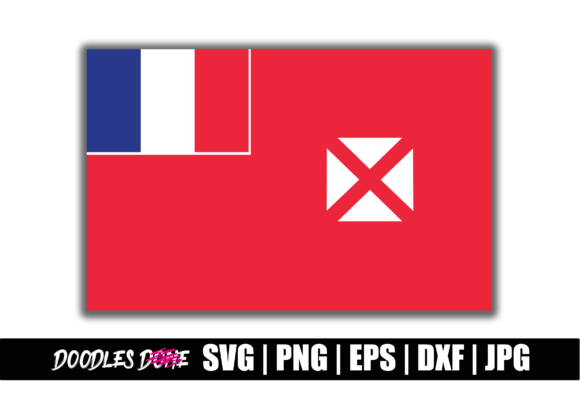
When I opened the Wallis and Futuna Flag SVG for the first time—prepping it for a custom embroidered tote bag for a Pacific heritage boutique—I felt an immediate sense of quiet confidence. The design isn’t flashy or overly detailed, but that’s its strength. It’s a balanced composition: three vertical bands (red, white, red) with the French flag in the upper left canton and the Wallis cross plus Futuna dove centered in white. No gradients, no drop shadows—just crisp, intentional geometry. As a designer who’s stitched hundreds of national and regional flags, I appreciate how this version avoids visual clutter while preserving symbolic clarity. It reads well at 3” wide on a linen tote, and feels equally at home on a baby onesie or a minimalist apron.
How It Performs Across Real Embroidery Projects
The Wallis and Futuna Flag SVG shines where simplicity meets storytelling—especially in handmade product lines that value authenticity over ornamentation. For custom apparel, it works beautifully on sweatshirts and unstructured caps when digitized with moderate stitch density and clean satin-stitched edges. On tote bags and kitchen towels, the bold red/white contrast holds up even with medium-thread-count cotton canvas. I tested it as an embroidered patch on twill backing, and the clean lines translated flawlessly—no bleeding, no thread nesting in corners.
For baby embroidery and nursery decor, the design’s gentle symmetry and lack of fine detail make it safer and more durable than intricate national emblems. It also fits naturally into holiday embroidery or wedding gifts for families with ties to Oceania—think monogrammed tea towels or pillow covers with subtle cultural resonance. As a digital embroidery file, its inclusion of SVG, EPS, DXF, PNG, and JPG means you can adapt it easily: convert to vector for laser-cut appliqué, use PNG for printable mockups, or import DXF into embroidery software for precise stitch planning.
Where to Use It Thoughtfully—Not Everywhere
That said, the Wallis and Futuna Flag SVG isn’t a one-size-fits-all embroidery file. Its clean layout becomes a liability on stretchy fabric like jersey knits unless stabilized heavily—those straight vertical bands pull noticeably if tension isn’t dialed in. On dark fabric, especially navy or charcoal, the white band needs careful thread selection; standard white polyester can look dull without a high-sheen alternative. And while it scales down decently, avoid using it under 2” on small hoop sizes—the French canton and dove details start to blur in fill stitch without manual cleanup.
I wouldn’t recommend it for curved surfaces like structured baseball caps without repositioning the design or adjusting underlay. And though it’s not text-heavy, the cross-and-dove motif sits close to the edge of the white band—if you’re stitching on textured fabrics like terry cloth or bouclé, those outer contours may soften unpredictably. Always test on scrap first, especially if layering it with other elements in a commercial embroidery job.
What It Adds to Your Handmade Product—and What It Doesn’t
This isn’t a “wow” design—it’s a “yes, this belongs here” design. That’s valuable. When used intentionally, the Wallis and Futuna Flag SVG elevates personalized gifts by signaling care and cultural awareness, not just decoration. Customers notice that. For an Etsy seller or small shop product, it adds quiet professionalism—no overpromising, no visual noise, just respectful representation. It supports brand consistency for Pacific-focused makers, and boosts giftability because it feels meaningful without being heavy-handed.
But it won’t carry weak execution. If your stitch density is too high on lightweight fabric, the white band will pucker. If you skip proper stabilizer, the red bars lose definition. And while it’s versatile as a graphics asset, remember: this is a Crafts-category file—not pre-digitized embroidery. You’ll need to convert and optimize it for your machine, fabric, and project goals.
Practical Notes Every Embroidery Designer Should Check
- Test on scrap fabric first—especially if pairing with dark or textured materials.
- Review thread color contrast: deep reds and bright whites behave differently on natural vs. synthetic fibers.
- Confirm hoop size compatibility before finalizing placement—some versions of the flag may extend beyond 4×4 boundaries depending on scaling.
- Inspect small details manually: the dove’s wingtips and cross arms are subtle—zoom in to ensure no gaps or overlaps in your digitized version.
- Test black-and-white mockups to verify legibility without color reliance.
- Compare light and dark fabric backgrounds—what reads clearly on ivory linen may disappear on heather grey.
- Use appropriate stabilizer: cutaway for stretchy knits, tear-away for stable wovens, and fusible for lightweight linens.
- Verify licensing terms before selling finished items or bundling the Wallis and Futuna Flag SVG into digital product kits—this affects your craft business compliance.
Final Thought: A Quiet Anchor in Your Design Toolkit
The Wallis and Futuna Flag SVG won’t shout—but it will stand. It’s the kind of design that earns trust over time: reliable in execution, respectful in intent, and flexible enough to support everything from a single embroidered patch to a full boutique collection. For creative entrepreneurs building thoughtful, culturally grounded products, it’s less about decoration and more about connection. Just remember: its strength lies in how you use it—not what it promises.