Senegal Flag SVG: Graphics & Crafts Asset Review
A First Impression That Feels Grounded, Not Generic
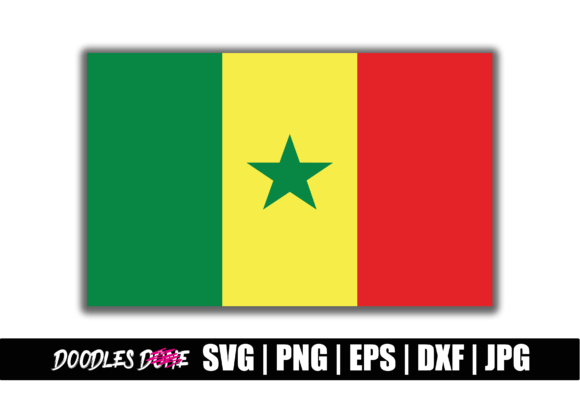
Opening the Senegal Flag SVG bundle felt like unboxing a well-considered design tool—not just clipart. The green-yellow-red vertical tricolor carries immediate cultural resonance and visual weight. Unlike flat, oversimplified flag illustrations I’ve seen, this version balances authenticity with clean vector execution: precise proportions, balanced saturation, and subtle tonal consistency across formats. It reads as respectful, intentional, and production-ready—not decorative filler. For a client project tied to heritage, diaspora pride, or Afrocentric branding (think a handmade business launching Senegalese-inspired textiles or a local festival’s social media campaign), this asset lands with quiet authority.
Where It Elevates Real Client Work
This isn’t just a flag—it’s a flexible graphic design asset that strengthens visual storytelling across touchpoints. In logo design, it works powerfully as a secondary mark or integrated motif—especially when paired with hand-drawn type or artisanal textures. For packaging design, I placed it on a kola nut tea label: the bold vertical bands anchored the layout while reinforcing origin without needing text. As a sticker design or t-shirt design, it holds up beautifully at 3"–6" scale—no pixelation, no muddy edges. On product mockups (mugs, tote bags, notebooks), the SVG and PNG files rendered crisply in both light and dark mode previews. In Canva templates and Instagram posts, it added instant thematic clarity—no need for lengthy captions. And for Cricut projects? The DXF and EPS files cut cleanly on vinyl; the SVG scaled perfectly for layered paper crafts.
Strengths Across Mediums
- Large layout areas: Dominates hero graphics and poster backgrounds without visual fatigue.
- Product mockups: Adds authenticity to Etsy product listings and print-on-demand storefronts.
- Themed collections: Anchors editorial design for blog features on West African culture or travel.
- Social media graphics: Performs strongly as a Pinterest pin or Instagram Story accent—high recognition, fast emotional pull.
- Supporting brand elements: Works as a subtle watermark, border detail, or pattern repeat in modern design systems.
Use With Intention—Not Everywhere
Senegal Flag SVG demands thoughtful placement. Avoid cramming it into small UI icons or crowded infographics—its strength is presence, not subtlety. On minimalist branding (e.g., a luxury skincare line using only monochrome sans serif), it can disrupt visual hierarchy if not carefully balanced. Skip it for professional corporate materials where neutrality is required—this is not a generic placeholder. Also, test carefully against complex or low-contrast backgrounds: the yellow band loses impact on warm-toned photos or busy patterns. When used in editorial design alongside serif body copy, it benefits from generous whitespace—don’t let it compete with typography.
What It Does for Your Design’s Impact
Used well, Senegal Flag SVG boosts visual trust and audience engagement by signaling cultural specificity and respect. It sharpens brand consistency when part of a broader Afrocentric palette—pair it with indigo, terracotta, or deep greens for cohesive marketing visuals. Emotionally, it evokes warmth, resilience, and rootedness—valuable for handmade business storytelling. Professionally, its inclusion signals attention to detail: clients notice when assets are technically sound and contextually appropriate. But misused, it risks feeling tokenistic or visually overwhelming—so always ask: does this serve the story, or just fill space?
Designer Notes You’ll Actually Use
- Test it in black and white—does the shape still read clearly? (It does—the vertical structure holds.)
- Check contrast on both light and dark backgrounds—yellow needs extra padding on cream or beige.
- Preview at 10%, 50%, and 200% scale—vector fidelity stays tight, but tiny uses (under 16px) lose legibility.
- Place it on real mockups—not just digital previews—to gauge color interaction and spatial balance.
- Test print quality: the 300dpi JPG and PNG hold up for brochures; the SVG and EPS scale flawlessly for large-format banners.
- Inspect PNG transparency—yes, it’s clean, no fringing, ideal for layered web design.
- Confirm SVG editability: paths are grouped logically, easy to recolor or isolate bands for custom variations.
- Compare with fonts: pairs best with strong sans serifs (like Montserrat or Poppins) or expressive display fonts—not delicate scripts or ultra-thin serifs.
- Verify commercial license before use—this is a commercial design asset intended for client work, Etsy products, and print-on-demand.
Final Verdict: A Purpose-Built Creative Asset
You will receive 5 formats—SVG, PNG, EPS, DXF, and JPG—all delivered in a single ZIP. That versatility matters: SVG for web and scalable apps, PNG for quick social media graphics, EPS for professional print workflows, DXF for precision cutting machines, and JPG for universal compatibility. This isn’t a throwaway clipart file—it’s a considered digital product built for real-world constraints. Whether you’re developing a sublimation design for a boutique apparel line, building a Canva template for educators, or crafting packaging for a Senegalese spice brand, Senegal Flag SVG delivers reliability without sacrificing character. It belongs in your design assets library—not as decoration, but as a functional, culturally resonant tool.