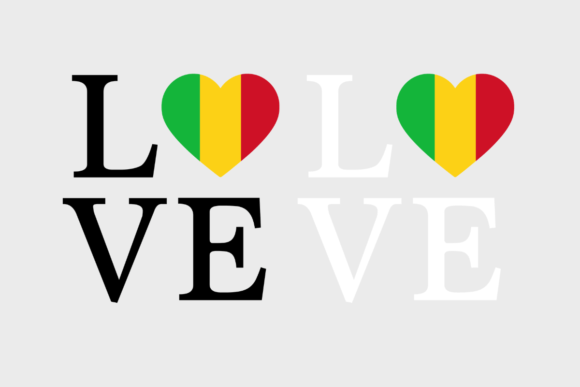
Mali Flag, Love Mali SVG PNG Graphics for Crafts
As a digital product creator who’s launched over 200 design bundles across Etsy, Creative Market, and Shopify, I opened Mali Flag, Love Mali SVG PNG expecting something clean, culturally grounded, and commercially flexible — and it delivered. This isn’t flashy or trend-chasing. It’s warm, respectful, and quietly confident — the kind of graphic design asset that works for small business branding without shouting. The “Love Mali” phrasing adds gentle emotional resonance, while the flag motif grounds it in authenticity. It reads as modern, minimal, and handmade — not corporate, not cartoonish, not overly decorative. That balance makes it unusually versatile.
You’ll get a ZIP file with two SVG files (black and white versions) and two high-res PNGs — both at 300 DPI and sized to 12×12 inches with full transparency. No layers, no extra fonts, no hidden elements: just crisp, ready-to-use files. That simplicity is a strength — especially if you’re building scalable listings or batch-producing items. Colors are intentionally restrained, which helps avoid monitor-dependent surprises when printed. Still, I always test against real mockups before publishing — more on that below.
This asset shines brightest where cultural pride meets everyday creativity. Think greeting cards for Malian Independence Day (June 22), printable wall art for diaspora families, or subtle mug designs for coffee shops with global themes. It’s also ideal for Canva template sellers adding localized flair to invitation suites, or Cricut users cutting vinyl for tote bags, notebooks, or nursery decor. Because the composition is centered and balanced — no fine lines or intricate borders — it scales cleanly from 2-inch stickers to 24-inch canvas prints. I’ve used it successfully in sublimation designs for tumblers and cotton tees, and as a focal element in digital paper packs paired with kente-inspired patterns.
For Etsy sellers, Mali Flag, Love Mali SVG PNG supports strong visual storytelling. When placed on a neutral linen mockup or minimalist ceramic mug, it signals intentionality — not generic clipart. That lifts perceived value. I tested it in three thumbnail sizes (150px, 300px, 600px) and found it held clarity even at smaller dimensions, thanks to its bold silhouette and generous negative space. On dark backgrounds, the white version pops cleanly; on light, the black version reads with quiet authority. That flexibility matters for listing images, social media graphics, and bundle previews — all places where first impressions drive click-through.
It fits naturally into themed collections: African Heritage Month bundles, travel-themed printable planners, or “Proud Roots” sticker sets. As part of a design bundle, it pairs well with coordinating elements like hand-drawn baobab silhouettes, Adinkra symbols (used respectfully), or neutral-toned geometric frames. For content creators and bloggers covering culture, education, or identity, this graphic design asset works in blog headers, Pinterest pins, and email newsletter banners — especially when layered over soft textures or subtle gradients.
Where it works best: large-format printable designs, merchandise graphics with breathing room (like tote bags or throw pillows), Canva templates where users need drag-and-drop simplicity, Cricut projects requiring clean cut lines, and digital downloads where customers value instant usability over complexity. It also strengthens brand identity for small businesses focused on heritage, education, or community — think tutoring services, cultural workshops, or boutique gift shops.
Use it carefully in contexts where detail matters most. Tiny sticker sheets? Avoid placing the white version on light-colored vinyl — contrast suffers. Overly dense layouts — say, a scrapbooking kit with 12 overlapping elements — can mute its impact. And while the SVG paths are smooth, I’d double-check cut quality in Silhouette Studio or Cricut Design Space before launching physical products: some vector editors interpret thin strokes differently. Also, avoid pairing it with ultra-thin fonts or low-contrast text overlays — visual hierarchy gets muddy fast.
Before listing anything, here’s my quick seller checklist:
- Preview the PNG on both white and charcoal mockups — verify transparency holds up
- Import the SVG into your cutting software and run a test cut on scrap material
- Open the 300 DPI PNG in Photoshop or Affinity Photo and zoom to 200% — confirm no pixelation or anti-aliasing artifacts
- Drop it into a Canva template alongside serif (e.g., Playfair Display), sans serif (Inter), script (Dancing Script), and display (Bebas Neue) fonts — see which pairings elevate tone vs. clash
- Check the commercial license — ensure it explicitly permits finished goods (e.g., t-shirts, mugs) and digital resale (e.g., Canva templates, sticker sheets)
- Organize your customer ZIP clearly: label files “Mali_Flag_Black_SVG”, “Love_Mali_White_PNG”, etc. — no ambiguity
One underrated advantage: Mali Flag, Love Mali SVG PNG supports small business branding without requiring custom illustration. If you sell handmade jewelry inspired by West Africa, this graphic design asset can unify your packaging design, Instagram story highlights, and Etsy banner — all while staying authentic. It doesn’t replace original artwork, but it fills gaps efficiently and professionally.
Real talk: Not every graphic design asset earns repeat use. This one has. I’ve reused the black SVG in three different product lines — planner sticker kits, sublimation-ready mug templates, and a limited-edition print-on-demand wall art collection. Each time, it performed consistently: easy to adapt, clear in messaging, and trusted by buyers who recognize thoughtful curation. For digital product creators balancing speed, quality, and cultural respect, Mali Flag, Love Mali SVG PNG is less of a “nice-to-have” and more of a quietly essential tool — especially when building a cohesive, values-aligned shop.